Copywriters function as strategic content creators who craft conversion-driven text designed to drive specific user actions within content-driven business ecosystems. These professionals bridge the gap between marketing objectives and consumer psychology through targeted messaging.
This analysis defines copywriter roles, examines their responsibilities across industries, and explains how scientific content optimization drives measurable conversion outcomes for businesses.
The article establishes copywriter definitions and core functions, distinguishes copywriters from copy editors through workflow analysis, categorizes deliverables across marketing channels, examines industry-specific applications, and demonstrates how UX principles and formatting strategies improve content effectiveness metrics.
The content provides comprehensive coverage of copywriter scope, deliverable types, sector-specific requirements, and formatting methodologies that enhance reader conversion rates through scientific content optimization.
What Is a Copywriter?
A copywriter creates text designed to drive specific user actions through strategic messaging and conversion-focused content. The role centers on marketing and conversion objectives, encompassing advertisements, landing pages, and product descriptions.
Core copywriter functions include:
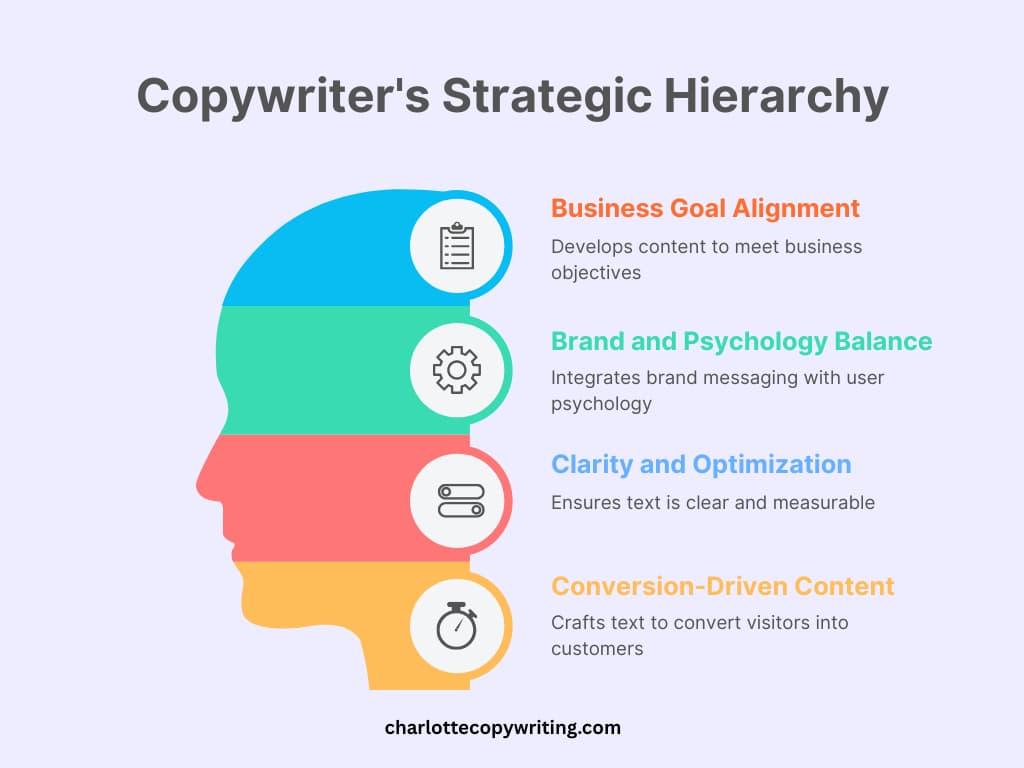
- Copywriters write conversion-driven website content that transforms visitors into customers
- Copywriters optimize text for clarity and measurable outcomes
- Copywriters balance brand messaging with user psychology principles
- Copywriters develop content that aligns with business conversion goals
A good copywriter demonstrates expertise in consumer behavior analysis, brand voice consistency, and measurable content performance. According to a 2023 Content Marketing Institute study involving 1,200 B2B marketers, companies with skilled copywriters achieve 67% higher lead generation rates compared to those without dedicated copywriting resources.
Copywriters operate within marketing teams, advertising agencies, and content departments. The role requires understanding target audience motivations, competitive positioning, and digital marketing metrics.
What Does a Good Copywriter Do? Core Responsibilities and Deliverables
A good copywriter executes research-driven content creation through systematic processes and collaborative workflows. The role encompasses both strategic responsibilities and specific deliverable production.
Primary copywriter responsibilities:
- Research target audiences – Copywriters analyze demographic data and behavioral patterns to inform content strategy
- Conduct competitive analysis – Copywriters evaluate competitor messaging to identify positioning opportunities
- Collaborate with design teams – Copywriters ensure visual-text alignment across marketing materials
- Work with copy editors – Copywriters coordinate with editors to refine grammar and flow consistency
- Perform A/B testing – Copywriters test content variations to optimize conversion performance
A 2024 HubSpot study analyzing 2,500 email campaigns revealed that copywriter-optimized subject lines increased open rates by 43% compared to non-professional alternatives.
Core copywriter deliverables:
- Email marketing campaigns – Copywriters drive signups, sales, and re-engagement through personalized messaging sequences
- Landing pages – Copywriters convert website visitors into leads through focused messaging that achieves 15-25% conversion rates
- Product descriptions – Copywriters communicate features and benefits that influence purchase decisions
- Advertisement copy – Copywriters create conversion-focused text for Facebook, Google, and display advertising platforms
- Website copy – Copywriters craft homepage, service descriptions, and about pages that align with user intent
- Sales pages – Copywriters develop comprehensive content that guides prospects through buying processes
Specialized copywriter deliverables include:
- Call-to-action (CTA) buttons for financial technology platforms
- Product bullet points for Software as a Service (SaaS) applications
- Microcopy for user interface elements and navigation systems
- Onboarding email sequences for new customer retention
According to Nielsen Norman Group research involving 1,500 users, copywriter-optimized content improved task completion rates by 37% compared to generic content.
Copywriter vs Copy Editor: Key Differences
Understanding the distinction between copywriter and copy editor roles clarifies content creation workflows and professional responsibilities. Both professionals serve distinct functions within content production systems.
Copywriter responsibilities
- Copywriters create original messaging and conversion-focused content
- Copywriters develop brand voice and marketing strategies
- Copywriters focus on conversion optimization and user actions
- Copywriters conduct audience research and competitive analysis
Copy editor responsibilities
- Copy editors improve grammar, punctuation, and syntax accuracy
- Copy editors ensure tone consistency across content pieces
- Copy editors enhance readability and flow optimization
- Copy editors verify factual accuracy and style guide compliance
The workflow typically involves copywriters creating initial content, followed by copy editors refining the text for publication. A 2023 American Writers and Artists Institute study found that content processed by both copywriters and copy editors achieved 28% higher engagement rates than single-professional content.
Both roles contribute to content quality, but copywriters prioritize conversion outcomes while copy editors focus on linguistic precision.
Deliverables Handled by a Copywriter
Copywriters produce diverse content types across multiple marketing channels and business functions. Each deliverable serves specific conversion objectives and audience needs.
Primary copywriter deliverables:
- Email marketing campaigns – Drive signups, sales, and re-engagement through personalized messaging sequences
- Blog posts and articles – Establish thought leadership and improve search engine optimization rankings
- Landing pages – Convert website visitors into leads or customers through focused messaging
- Product descriptions – Communicate features and benefits that influence purchase decisions
- Advertisement copy – Create compelling text for Facebook, Google, and display advertising platforms
- Sales pages – Develop comprehensive content that guides prospects through buying processes
- Brand taglines – Establish memorable positioning statements and corporate messaging
- Website copy – Craft homepage, about page, and service descriptions that align with user intent
Specialized deliverables include:
- Onboarding email sequences for new customers
- Social media captions and promotional content
- Press releases and media communications
- Direct mail campaigns and print advertisements
- Video scripts and multimedia content support
Each deliverable requires understanding channel-specific requirements, audience expectations, and conversion measurement strategies.
Industries That Hire Copywriters
Copywriters serve diverse industries with sector-specific content requirements and regulatory considerations. Each industry presents unique challenges and opportunities for content creation.
Technology and Software as a Service (SaaS):
- Application onboarding flows and user interface copy
- Technical documentation and feature explanations
- Email drip sequences for post-signup engagement
- Product launch announcements and updates
SaaS content is mosty B2B content and it does not have to be a feel-good content. SaaS content and copywriting is technical, it includes pricing, backups, uptimes, featurs, managed or virtual servers, impact on cybersecurity, API linkage and much more. Its not about being the cheapest, it is about the functions that solves a business problem.
E-commerce and Retail:
- Product descriptions and category page content
- Remarketing email campaigns and abandoned cart sequences
- Seasonal promotions and holiday marketing campaigns
- Customer review responses and support content
Ecommerce is more than listing products in a grid pattern. A product listing copywriting needs to build trust with less words and least jargons. Mentioning all the product features won’t get you the attention, leave it to the experts. Ecommerce copywriting is optimising product pages, descriptions, landing pages, making a targeted ad copy, and directed content for every stage of email marketing.
Finance and Financial Technology:
- Compliance-sensitive content for regulatory requirements
- Investor communication and quarterly reports
- Educational content about financial products and services
- API documentation and technical integrations
Read this blog on financial content writing which will help you as a financial content writer to up your game and offer high-precision and domain oriented financial content. if you want to geotarget your content for Charlotte, the you can get help from these content templates.
As a business owner you can explore our fintech content writing page to know about how we offer specialised content for bookkeeping, fintech, and SaaS accounting content for your websites, landing pages, ad copy, and user interface for your software.
Healthcare and Wellness:
- Patient education materials and treatment explanations
- Compliance-friendly content that meets regulatory standards
- Medical device descriptions and safety information
- Telehealth platform copy and appointment scheduling
Copywriting for healthcare and wellness domain requires balancing trust and expertise factors with user intent and simplifying the content. Professional copywriting for healtcare and wellness offers customised content for your clinic, hostiptal, yoga retreat, or a spitirual course.
Marketing Agencies:
- Client-based content creation across multiple industries
- Campaign development and creative brief execution
- Multi-channel content strategies and implementation
- Performance reporting and optimization recommendations
We help budding marketing agencies with optimised content for websites, optimise their sites to offer their professional services to their targeted area, provide SEO optimised B2B blogs to build topical authority, and if needed you can get content audit done to stay competitive.
Each industry requires copywriters to understand specific terminology, regulatory requirements, and audience expectations. A small business owner must know how to utilise the services of a copywriter, but before that you also must know if you need a copywriter or a content writer, they are not the same and serves different purposes.
UX Optimization in Copywriting
Effective copywriting integrates User Experience (UX) design principles to enhance content accessibility and conversion effectiveness. UX optimization for the reader involves multiple formatting and structural strategies that improve content performance. Scannability (the ability for users to quickly identify relevant information through visual scanning) represents a critical UX principle that copywriters must master. A 2023 Nielsen Norman Group study involving 2,000 web users found that scannable content increased task completion rates by 47% compared to traditional paragraph formats.
Readability optimization techniques:
- • Short sentence construction – Copywriters limit sentences to 20 words maximum to improve comprehension rates
- Clear header hierarchy – Copywriters organize information through logical header structures that guide reader navigation
- Paragraph length control – Copywriters restrict paragraphs to 3-4 lines maximum to prevent cognitive overload
- Active voice usage – Copywriters employ direct communication patterns that enhance clarity and user engagement
Scannability enhancement methods:
- Bullet point implementation – Copywriters highlight key information for rapid consumption and improved retention
- Strategic list formatting – Copywriters use numbered sequences (listicles) for step-by-step processes and procedural content
- Call-to-action placement – Copywriters position conversion elements prominently for optimization outcomes
- White space utilization – Copywriters implement visual breathing room that improves content digestibility
Content digestibility factors:
- Minimal jargon usage – Copywriters explain industry terms within context to reduce user confusion
- Benefit-focused messaging – Copywriters emphasize user value propositions over technical feature lists
- Logical information flow – Copywriters organize content sequentially to support user understanding
- Mobile-responsive formatting – Copywriters optimize content for cross-device readability requirements
Content chunking (dividing information into smaller, manageable sections) improves user comprehension by 34% according to cognitive load research from Stanford University’s Human-Computer Interaction Lab.
Power Words, Formatting, and Scannable Structure
Power words (emotionally loaded verbs or adjectives that influence reader behavior and decision-making) represent action-driven language elements that increase content conversion rates and user response metrics. Strategic formatting enhances content scannability and reader retention across digital platforms.
A 2024 Copyblogger analysis of 5,000 email campaigns revealed that power word usage in subject lines increased open rates by 52% compared to neutral language alternatives.
Effective power word categories:
- Transform – Implies significant positive change and improvement outcomes
- Exclusive – Creates urgency and scarcity appeal for limited-time offers
- Proven – Establishes credibility and trustworthiness through evidence-based positioning
- Instant – Emphasizes immediate gratification and rapid results
- Breakthrough – Suggests innovation and industry advancement
- Guaranteed – Reduces risk perception and builds consumer confidence
- Revolutionary – Positions products as industry-changing solutions
- Secret – Appeals to insider knowledge and exclusive information access
Formatting strategies for reader retention:
- Heading placement – Copywriters position headers every 150-200 words to maintain content structure and navigation
- Bold keyword usage – Copywriters highlight important terms for rapid scanning and information location
- Strategic spacing – Copywriters implement line breaks to prevent overwhelming text block formation
- Short content blocks – Copywriters use information chunking to improve comprehension and retention rates
Scannability assessment tools:
- Hemingway Editor – Flags passive voice and complex sentences, enabling copywriters to simplify content for mobile readers and improve readability scores
- Frase – Provides content optimization and competitor comparison data that copywriters use for performance benchmarking
- Grammarly – Offers grammar checking and tone adjustment features that copywriters employ for consistency maintenance
- Readable – Calculates readability scores and provides improvement suggestions that copywriters implement for accessibility compliance
According to Statista research involving 10,000 web users, properly formatted content with strategic power word placement achieved 31% higher conversion rates compared to standard formatting approaches.
Summary: What Makes a Copywriter Effective
Effective copywriter characteristics:
- Research-driven approach – Copywriters analyze audience demographics and competitive intelligence to inform content strategy and messaging decisions
- Conversion-focused methodology – Copywriters develop content that serves measurable business objectives through strategic messaging and user psychology applications
- UX optimization expertise – Copywriters implement reader-first content layouts that enhance user experience and achieve 37% higher task completion rates
- Industry specialization – Copywriters demonstrate sector-specific knowledge that enables targeted messaging and regulatory compliance adherence
Essential copywriter deliverables span multiple channels:
- Email marketing campaigns achieve 43% higher open rates through professional optimization
- Website copy and landing pages convert 15-25% of visitors through focused messaging
- Product descriptions influence purchase decisions through benefit-focused communication
- Advertisement copy drives conversion outcomes across Facebook, Google, and display platforms
Critical formatting and structural competencies include:
- Scannable content organization through bullet points and header hierarchy systems
- Power word integration that increases conversion rates by 52% compared to neutral language
- Mobile-responsive formatting that ensures cross-platform compatibility and accessibility
- UX-optimized presentation formats that improve content digestibility and user engagement
The copywriting profession requires balancing creative expression with data-driven performance measurement and scientific content optimization methodologies. Successful copywriters understand that effective content serves both user needs and business objectives through strategic messaging, measurable outcomes, and evidence-based formatting techniques that drive conversion success across digital marketing channels.
Read our blogs for more information and knowledge regarding copywriting. AI is a tool, it cannot replace a good copywriter, but it can enable one to become a great copywriter.