Traditional copywriting is persuasive writing for marketing, SEO copywriting adds another layer – optimizing that content for search engines.
Copywriting generally means writing persuasive content that drives action. Traditional copywriting focuses on emotional appeal, storytelling, and strong calls-to-action to influence readers. The copy you see in print ads, billboards, brochures, or radio jingles – that’s usually traditional copywriting at work.
SEO copywriting, born of the internet age, involves crafting content that is not only persuasive but also optimized for search engines like Google, Bing, MSN, DuckDuckGo, etc.
Shoppers these days picks up the phone and searches for what they want to “know about” or “what they want to buy”. Even on websites like Amazon, the most used element is the search bar. Digital world is itself your print ads, billboards, brochures, etc. and YouTube, TikTok, Instagram reels, etc. are your new age replacement for radio and TV advertisements.
Traditional copywriting persuades and drives action. SEO copywriting ensures this content reaches the shopper through search engines like Google.
Rajat Jhingan
Traditional copywriting speaks only to the audience (humans), while SEO copywriting speaks to both humans and algorithms (search engines).
As a Charlotte business owner, you might need both at different times. A print advertisement in South End for your new boutique would rely on traditional copywriting to captivate readers. A landing page for your boutique’s website would employ SEO copywriting so that people searching “unique fashion stores in Charlotte” can find you on Google and then be persuaded by your content once they click through.
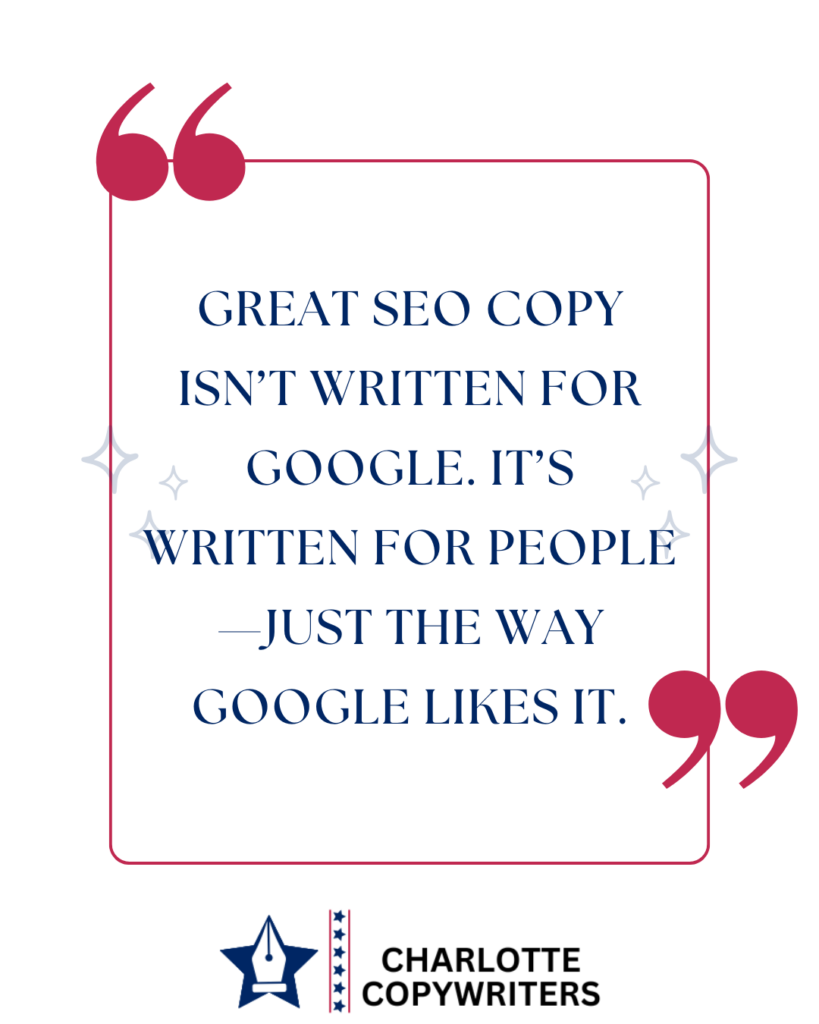
“It is not audience vs. algorithm, it is audience and algorithm. The digital infrastructure outlines how our marketing should be. Remember that adge: Medium is the message.”
Rajat Jhingan
Approximately 9 billion searches are done on Google, DAILY! Which means, millions of ‘search queries’ per second and out of that 22% are done by shoppers and yet 99% of those searches never click beyond the first page of Google’ Search Engine Results Page (SERP).
Global e-commerce sales are projected to cross $7 trillion by the end of next year and businesses are investing heavily in websites, sales bots, and SEO.
But what about content? Can AI generated content enough! When everyone has AI, then what makes you stand apart! The human-touch, the persuasion, the feeling of belongingness.
Traditional copywriting is the billboard you notice during your commute, the slogan you can’t forget, or the radio ad that makes you pause. It’s made for immediate action—be it curiosity, a purchase, or a shift in perception. No keyword targets. Just resonance.
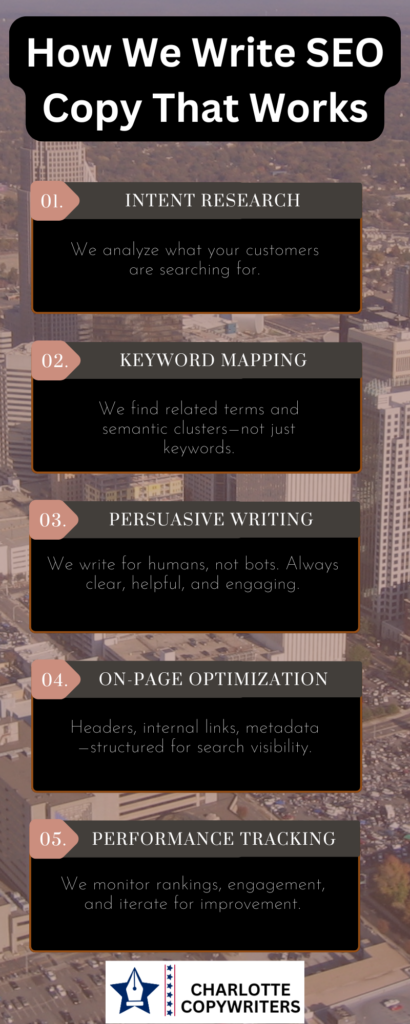
SEO copywriting, weaves in relevant keywords, aligns with search intent, and follows structural norms preferred by algorithms—all while staying readable, relatable, and persuasive.
A Good Copy or a Good SEO?
Charlotte has a growing population that relies heavily on digital search for solutions (think about how often you use Google Maps or search to find a service nearby).
If your content isn’t SEO-optimized, you lose out on those opportunities. Conversely, simply ranking on Google isn’t enough if the writing doesn’t connect with the reader.
As Rajat Jhingan advises, “Google might bring you the visitor, but it’s your message that turns them into a customer.” – Rajat Jhingan. In other words, SEO can get folks to your virtual door, but great copy seals the deal.
You cannot leave one and focus on another, a good copy is the payload and good SEO is the rocket. For more understanding consider a good copy and content are the pizza, while the advertizing of that pizza joint is SEO. What’s the use of making a great pizza if the customer don’t know that your restaurant exists, in the contrary, you market your upscale fancy restaurant, the diner comes in, but the food is stale! I think you got the point!
SEO copywriting, by contrast, must perform double duty. It weaves in relevant keywords, aligns with search intent, and follows structural norms preferred by algorithms—all while staying readable, relatable, and persuasive.
It takes a lot of expertise to write SEO optimized articles. It not just stuffing the keywords, but addressing the:
customers pain points,
search intent,
genuinely guiding or aiding in making a purchase decision,
understanding buyer psychology.
All this and, balancing it with :
design principles,
content presentation,
demands of search algorithm (on-page and off page SEO),
meeting the competition from webpages marketing similar offerings etc.
Understanding when to make a website, when to make a landing page for your business. And, if you already have a website then repurposing the content to make it relevant, optimized to SEO principles, while adhering to the copywriting rules. Overwhelming!. Leave these things to us.
How SEO Copywriting Aligns with Search Intent and Google’s EEAT
Contrary to belief, SEO copy isn’t just stuffing phrases like “best plumber in Austin” into every sentence. Effective SEO copy:
Answers specific user questions (People Also Ask, anyone?)
Uses internal links to guide navigation and improve session duration
Aligns with search intent: Is the user looking to buy, learn, or compare?
Google’s algorithms favor content that shows experience and expertise (EEAT). That means real examples, authoritative tone, and unique value—not repackaged fluff.
Traditional Copywriting in Action: The Art of the Immediate Hook
Whether it’s a magazine spread or a billboard on I-95, traditional copywriting is about being memorable. It works when:
You have a captive audience (e.g., a commuter, a radio listener)
You want emotional persuasion over informational depth
The message doesn’t need to be found via search—just remembered
Example: A radio ad for a bakery might say: “When your day starts with warm cinnamon rolls, everything else just falls into place.”
No keywords. Just imagery and sentiment.
Key Functional Differences (and Where Each Excels)
Often long-form (optimized for depth and keywords)
Tone
Emotion-first, highly creative
Balanced between clarity, utility, and persuasion
Structure
Linear storytelling or direct appeal
Structured with headings, bullets, and internal links
Performance Metrics
Response rate, sales lift, brand recall
Organic traffic, dwell time, bounce rate, SERP rankings
Keyword Usage
Not applicable
Integral (but must be seamless and relevant)
Can They Work Together? Absolutely.
The smartest strategy for Charlotte businesses is to integrate SEO copywriting with traditional copywriting practices. In practical terms, this means:
Use SEO tactics to make your blog or product page findable.
Use traditional copy techniques (like storytelling, rhetorical questions, metaphors) to keep the reader hooked and inspired to act.
How Charlotte Businesses Can Implement Copywriting with SEO Practices
Perform keyword research for your online content, but don’t force keywords where they don’t fit. Use them naturally. (It’s important to avoid keyword stuffing, which makes text read awkwardly and can even hurt your SEO). For example, if “Charlotte HVAC repair” is your keyword, you might write a sentence like: “We provide fast, reliable Charlotte HVAC repair services – keeping your home comfortable year-round,” which flows naturally and hits the keyword.
Maintain your brand voice and persuasive flair. Just because something is SEO-oriented doesn’t mean it should sound robotic or generic. Traditional copywriting skills come into play by infusing personality, whether it’s humor, professionalism, or warmth, into your content. A law firm in Uptown might have a formal and trustworthy tone in their web copy, while a trendy restaurant in NoDa can be playful – both can still be SEO-friendly.
Use traditional copy techniques in SEO content: Start with a hook (just as you would in an ad) to grab the reader’s attention, even if it’s a blog post. Use storytelling or local references (mentioning a scenario in Charlotte the reader can relate to) to engage. Then guide the reader to a call-to-action, like contacting you or reading another article. Internal linking can help here – for example, an SEO-focused blog post about “SEO Based Blog Writing Services in Charlotte” might internally link to your Copywriting Services in Charlotte page for readers who want professional help, creating a smooth pathway for conversion. A good copywriter is also a good copy editor, who maintains the logical flow, removes linguistic impurities, makes the content easily understandable, break boring text-walls into images, infrographics, listicles, etc., to get more engagement and reading time for your blog.
Leverage data and credibility: SEO content often benefits from including facts, figures, or examples (which can also enhance E-E-A-T – Experience, Expertise, Authoritativeness, Trustworthiness – a concept we’ll explore later). Traditional copy might rely on slogans or emotional appeal, but in SEO copy you can mix in a stat like “80% of Charlotte shoppers check online reviews before visiting a store” to emphasize the importance of content, which strengthens the persuasive element with evidence.
Final Takeaway
By blending the science of SEO with the art of copywriting, you’ll speak the language of both algorithms and Charlotteans – and that’s a winning formula for growth. Mastering both ensures that whether your customer’s journey starts on Google or with a flyer on a South End bulletin board, it ends with them knocking on your door (or inbox).
Charlotte businesses need the visibility that SEO-focused content provides in online searches and the persuasive punch of classic copywriting to convert interest into action.
A copywriter drives action with persuasive writing (think ads or product pages), while a content writer educates and informs (like blogs or guides). You often need both. Building brand loyalty needs a content writer and for selling, you neeed a copywriter. But both need SEO skills along with professional writing skills too.
Q2: What’s the key difference between SEO copywriting and traditional copywriting?
SEO copywriting focuses on search visibility and conversions, while traditional copywriting focuses purely on persuasion, often for offline or broadcast media. A professional copywriter must keep himself/herself updated with technological changes, SEO updates, user behaviour, language and cultural nuances along with industry specific jargons.
Q3: Will SEO copy affect the readability of my content?
Not at all. Good SEO copywriting blends keywords seamlessly into natural, engaging language that humans enjoy reading. Rather a work of a professional copywriter will integrate SEO into a good copy making it readable, cohesive, and action oriented.
Q4: How does SEO copywriting improve Google rankings?
It targets search intent using relevant keywords, structured formatting, and authoritative content that meets Google’s EEAT criteria. A professional copywriter knows and applies SEO knowledge while creating the content. You can browse our copywriting services to get an idea.
Q5: Can traditional copy be reused for online platforms?
Yes, but it should be adapted with SEO elements like keywords, metadata, and internal linking to perform well online.
Q6: How do I know if my existing content needs SEO optimization?
Check if it ranks on search engines, answers real user questions, includes relevant keywords, and aligns with your target audience’s intent. You may need to repurpose the content to align it with digital media and SEO principles. You can send us a query regarding content repurposing services.
Q7: How long does it take to see results from SEO copywriting?
It varies, but typically, SEO-optimized content starts gaining traction within 3–6 weeks depending on competitiveness and domain authority. Yes, SEO is a game of patience, thorough research, and expert execution.
Q8: Is keyword stuffing still effective?
No. Keyword stuffing harms readability and SEO. Modern algorithms prioritize relevance, readability, and user satisfaction.
Q9: Can you help repurpose my offline content for SEO?
Yes. We transform your brochures, radio scripts, and flyers into SEO-optimized digital content that ranks and converts.
Q10: Do you provide industry-specific content and copywriting services?