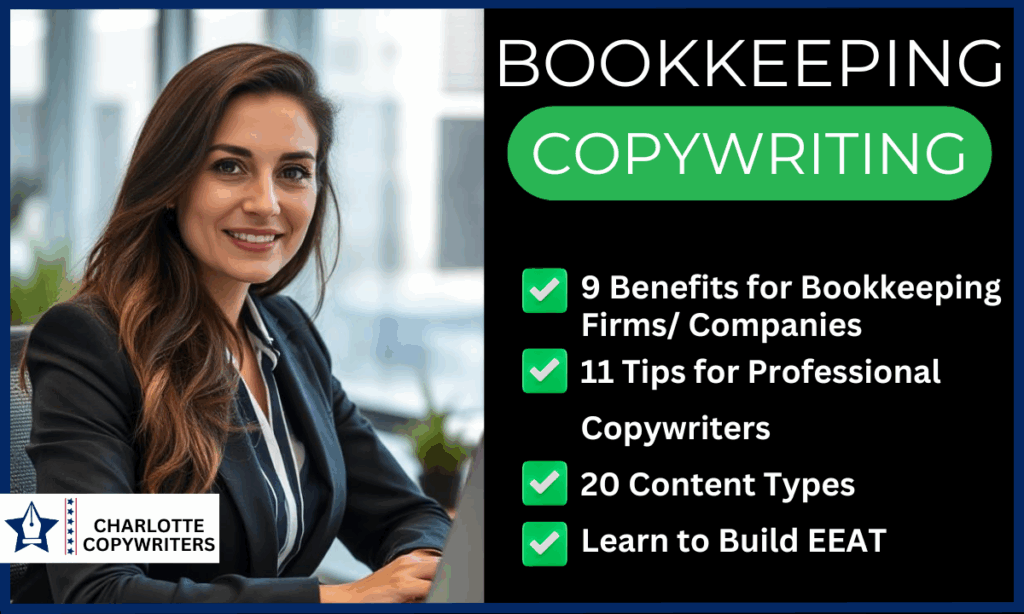
Hiring a professional copywriter can transform a bookkeeping or accounting firm’s digital presence. Strategic copy elevates visibility, drives qualified leads, and improves conversion by articulating complex financial services with clarity and authority.
A skilled bookkeeping copywriter brings subject-matter fluency in tax codes, financial systems, and compliance requirements—combined with expertise in direct-response writing, search optimization, and conversion design. This dual competency ensures that your service offerings are communicated accurately and persuasively across all client touchpoints, from landing pages to lead magnets.
Content in the financial and fintech sectors requires more than generic writing—it demands precision, technical depth, and alignment with Google’s E-E-A-T framework (Experience, Expertise, Authoritativeness, and Trustworthiness). Without this, content fails to rank or convert in highly regulated YMYL (Your Money or Your Life) categories.
What you’ll learn in this article:
- How copywriting improves SEO, lead generation, and client retention for bookkeeping firms
- Ways professional content clarifies complex services and builds client confidence
- The role of content strategy in aligning with search intent and funnel stages
- Practical tips for optimizing financial copy across web, email, and lead magnets
- How to combine content writing and copywriting to create a full-funnel content engine
- How to build E-E-A-T and outperform competitors with authoritative, compliant messaging
9 Ways Copywriting Impacts Your Bookkeeping Business
1.Lead Generation
Copywriting enables lead generation by aligning content with the search behavior and conversion triggers of high-intent bookkeeping prospects. Semantic keyword clusters—such as “small business bookkeeping,” “outsourced tax services,” and “freelancer accounting plans”—attract qualified organic traffic.
Content formats such as service pages, blog articles, and downloadable assets (e.g., tax calendars, onboarding checklists) function as lead conversion channels.
Practical benefits of lead-generation copywriting:
- Higher visibility for transactional keywords improves discovery by users actively searching for bookkeeping solutions.
- Downloadable content and blog posts initiate micro-conversions and email list opt-ins.
- Localized CTAs and trust signals (e.g., CPA licenses, testimonials, service guarantees) increase form submission rates by 12.7 percent (HubSpot, 2024).
Targeted writing answers transactional queries like “how much does monthly bookkeeping cost” or “best bookkeeping software for startups,” guiding users toward bottom-funnel actions such as booking consultations.
On-page copywriting tactics that generate leads:
- Action-oriented CTAs like “Book a Free Consultation” or “Get a Custom Quote” move users to contact forms.
- FAQ sections and structured markup (e.g., FAQPage, LocalBusiness schema) enhance indexability and support featured snippet eligibility.
- Consistent brand tone and messaging clarity reduce bounce rates and improve user retention on landing pages.
Content that fulfills informational needs while removing ambiguity in service offerings results in higher lead qualification and stronger conversion intent.
2. SEO Visibility
Copywriting structured around semantic SEO improves search engine visibility by embedding high-intent, context-rich keywords within structured content formats. Keyword clusters such as “GAAP for small businesses,” “QuickBooks reconciliation,” and “state-specific tax compliance” enhance topical depth and align with search behavior.
Optimized on-page elements—including headings, metadata, and internal linking—signal relevance and support ranking eligibility.
Practical SEO benefits of strategic copywriting:
- Increased organic traffic from long-tail and localized queries reduces reliance on paid channels.
- Topic clustering and internal linking improve crawl depth and strengthen semantic content hierarchy.
- Schema markup integration (e.g., Article, FAQ, HowTo) improves eligibility for enhanced search results and featured snippets.
Copy that includes latent semantic indexing (LSI) terms and consistent terminology supports entity recognition in the Knowledge Graph. Pages benefit from sustained visibility and lower cost-per-acquisition.
Technical enhancements driven by copywriting:
- Content optimized for EEAT earns trust-based ranking signals, particularly on YMYL (Your Money or Your Life) financial topics.
- Clean HTML structure and proper use of headings support mobile usability and page experience scores.
- Backlink potential increases with original, authoritative insights and data-backed perspectives.
Sustained SEO visibility translates to compounding lead acquisition, long-tail keyword capture, and higher engagement rates from organic sessions.
3. Service Clarity
Copywriting defines the scope, structure, and delivery model of bookkeeping services with precision. Clear segmentation—such as “monthly reconciliation,” “1099 filings,” and “multi-entity reporting”—removes ambiguity from the service proposition.
Precise descriptions reduce client confusion and increase the likelihood of informed conversions.
Practical service communication benefits of precise copywriting:
- Clear differentiation between service tiers (e.g., basic vs. advanced bookkeeping) aligns user expectations with deliverables.
- Defined onboarding workflows reduce client hesitation and improve operational readiness.
- Compliance-aligned descriptions improve trustworthiness and reduce regulatory friction.
Use of glossary content, visual flowcharts, and Q&A blocks enhances comprehension for non-expert visitors while reinforcing technical credibility.
Conversion-centric outcomes of service clarity:
- Lower pre-sale friction as visitors quickly identify services matching their needs.
- Decreased service inquiries due to self-service comprehension through content.
- Improved qualified lead generation by repelling unfit prospects and focusing on target profiles.
Structured service copy aligned with schema.org types (e.g., Service, OfferCatalog) further improves
4. Conversion Optimization
Copywriting optimizes conversion pathways by aligning message structure with user decision stages. Content architecture—from awareness-driven blogs to transactional landing pages—facilitates movement through the funnel.
Tactical integration of CTAs, benefit-focused copy, and UX-aligned formatting improves interaction and drives action.
Practical conversion benefits of optimized copywriting:
- Tailored CTAs (“Start Your Free Trial,” “Speak with a CPA Today”) increase user clicks and form completions.
- Placement of trust cues (certifications, secure badges, response time disclosures) decreases exit rates and builds confidence.
- Behavior-driven layout (above-the-fold messaging, scroll-triggered buttons) matches attention patterns and improves funnel progression.
Content refinement using behavior analytics (e.g., heatmaps, click tracking, scroll depth) ensures continuous optimization through A/B testing and conversion rate diagnostics.
Technical and behavioral impacts of conversion-focused copy:
- Increased time-on-page due to relevance-matching headlines and visual hierarchy.
- Higher submission rates from landing pages that articulate exact service benefits with minimal cognitive load.
- Reduced abandonment via concise, informative copy that mitigates uncertainty and friction.
Each word on the page contributes to micro-decisions that culminate in a macro-conversion—copywriting ensures alignment at every point.
5. Client Retention
Copywriting sustains client relationships through continuous value delivery and informational alignment. Post-conversion communication—via emails, knowledge bases, and onboarding guides—reinforces engagement and trust.
Retention content addresses recurring concerns, regulatory updates, and operational support, reducing client churn.
Practical retention benefits from strategic content writing:
- Lifecycle emails and service updates maintain contact frequency and increase retention touchpoints.
- Educational materials (e.g., compliance guides, tax checklists) reaffirm client value perception.
- Proactive content addressing upcoming filing deadlines or policy changes prevents friction and establishes reliability.
Messaging consistency across platforms ensures familiarity and strengthens brand recall. Copy that integrates personalization and regional context improves client relevance and long-term satisfaction.
Operational retention outcomes:
- Decreased support tickets through detailed FAQs and self-service content.
- Higher renewal rates linked to perceived expertise and ongoing advisory content.
- Improved upsell success via timely education around additional service needs.
Retention-focused copywriting maximizes customer lifetime value (CLTV) by extending engagement beyond the initial sale.
6. Differentiation in a Saturated Market
Copywriting establishes competitive distinction by articulating firm-specific advantages with clarity and precision. In a market where services often appear interchangeable, specialized language, unique methodologies, and niche targeting provide differentiation signals.
Consistent brand voice and expertise-driven messaging reinforce memorability.
Practical differentiation benefits enabled by content:
- Showcasing specialization (e.g., bookkeeping for SaaS firms or medical practices) attracts niche clients.
- Demonstrating proprietary processes (e.g., automated workflows, real-time dashboards) validates operational maturity.
- Emphasizing credentials and partner affiliations (e.g., QuickBooks ProAdvisor, Xero Silver Partner) signals credibility and authority.
Copywriting helps position firms as premium, trusted, or tech-enabled—depending on the target persona—through intentional tone, structure, and vocabulary.
Market positioning outcomes from differentiated copy:
- Stronger brand recall through unique language and consistent value themes.
- Increased sales enablement as copy simplifies elevator pitches across digital touchpoints.
- Reduced price sensitivity when value communication outpaces generic competitor claims.
Well-crafted messaging enables firms to rise above commoditized service language and anchor themselves in unique buyer mindsets.
7. Nurturing Client Confidence
Copywriting fosters trust and transparency, critical in financial service environments where data sensitivity and regulatory compliance are non-negotiable. Confidence is built through clear, credentialed, and well-documented messaging across web and email content.
Clarity in value delivery, accessibility of expert voices, and visibility into service workflows are central to trust formation.
Practical confidence-building benefits of expert copywriting:
- Display of professional credentials and certifications (e.g., CPA, CMA, EA) confirms qualification.
- Testimonials, client success stories, and case studies provide social proof.
- Transparent descriptions of processes and deliverables reduce perceived risk.
Content that defines timelines, tools used, and security protocols demonstrates operational maturity and accountability.
Trust-centric outcomes of confidence-driven copy:
- Higher onboarding confidence as users see the exact service pathway post-signup.
- Increased repeat engagement when perceived expertise aligns with messaging tone and factual accuracy.
- Enhanced referrals and word-of-mouth driven by high-confidence, informed client relationships.
Copywriting reinforces reliability not by persuasion but by evidence—through structured, verifiable, and expectation-aligned content.
8. Increasing Brand Value, Recall, and Retention
Copywriting establishes brand identity through consistent tone, terminology, and thematic structure across digital assets. Repetition of unique messaging elements—such as core values, differentiators, and service guarantees—enhances memorability and positions the firm within a specific client archetype.
Brand-centric content extends beyond aesthetic to deliver informational and emotional resonance.
Tangible brand-building benefits from strategic content:
- Increased brand recall through repetitive, high-frequency exposure to core value propositions.
- Higher perceived value when tone, layout, and voice reflect professionalism and authority.
- Stronger emotional connection via storytelling, founder narratives, and personalized team showcases.
A cohesive brand experience reduces churn by making the firm memorable and familiar. Email sequences, social content, and blog updates reinforce identity and sustain attention over time.
Retention outcomes driven by brand-aligned messaging:
- Greater client loyalty from trust built through consistent communication themes.
- Higher engagement on branded content due to relevance and emotional consistency.
- Easier expansion into new services when trust in the brand translates into openness to upsells.
9. Reduces Long-Term Marketing Expenditure by Generating Organic Traffic
Copywriting that aligns with semantic SEO and EEAT principles provides durable, compounding returns by replacing ongoing paid acquisition with long-term visibility in search.Informational blog posts, evergreen service pages, and resource hubs maintain ranking authority with minimal post-publication cost.
Cost-efficiency benefits from SEO-optimized content:
- Lower customer acquisition costs (CAC) compared to paid media or third-party leads.
- Continuous lead inflow from high-performing pages optimized for intent-rich queries.
- Higher ROI due to persistent visibility in unpaid SERPs across multiple funnel stages.
Google prioritizes content that demonstrates depth, expertise, and originality. Pages that match these criteria not only rank longer but also require fewer refresh cycles.
Strategic outcomes from reduced marketing spend:
- Scalable growth without proportional ad spend increases.
- Increased marketing elasticity to reallocate budget toward innovation or retention.
- Sustained brand presence even in low-budget or high-competition environments.
Investing in content-based lead engines shifts marketing from expense to asset.
Copywriting and Content Writing Mix for Bookkeeping Agencies
Bookkeeping agencies require both copywriting and content writing to grow and convert effectively. Each serves a distinct function:
- Copywriting drives direct actions. It’s used in homepage headlines, service pages, landing pages, and sales emails.
- Content writing builds long-term visibility. It’s used in blog posts, how-to articles, whitepapers, case studies, and knowledge hubs.
Both are essential. Copywriting gets clients in the door. Content writing keeps them engaged and builds trust.
Choosing between sales copy and educational content depends on four key elements:
- Content Strategy and Planning: What are the business goals? Are you promoting a service or building authority?
- Content Lifecycle: Is the message time-sensitive (offer) or evergreen (how-to guide)?
- Content Distribution: Is it being sent via email, posted on a blog, or shared on social media?
- Marketing Funnel Stage: Are you attracting visitors (top), educating leads (middle), or converting clients (bottom)?
Use sales copy for landing pages, consultation CTAs, or promotional banners. Use educational content for answering questions, simplifying tax concepts, or helping users compare services.
Bookkeeping firms benefit from aligning message types with funnel stages:
- Top of Funnel: Blogs and infographics to attract and inform.
- Middle of Funnel: Case studies, checklists, and comparison guides to engage.
- Bottom of Funnel: Testimonials, CTAs, and landing pages to convert.
To execute this strategy, a skilled copywriter with accounting knowledge is essential. They understand compliance nuances, financial terminology, and how to write both persuasive and authoritative content.
When combined, copywriting and content writing create a seamless user journey:
- Website copy pulls attention and encourages action.
- Educational content answers questions and removes objections.
- Consistent updates—through newsletters or blogs—nurture ongoing relationships.
This blend supports both client acquisition and retention, transforming your website into a lead engine and your content into a trust-building asset.
11 Tips for Writing Copy That Converts for Bookkeepers
1. Simplicity and Authority
Clarity builds trust. Keep language precise and professional.
- Use short sentences and active voice.
- Avoid jargon unless clearly defined.
- Prioritize factual, declarative statements.
2. Client-Centric Framing
Always position content from the client’s perspective.
- Emphasize outcomes over features.
- Translate technical service tasks into business value.
- Use “you” more than “we.”
3. Strategic Keyword Placement
Align copy with SEO while maintaining readability.
- Insert high-intent keywords into headers and opening sentences.
- Use LSI terms to enhance semantic relevance.
- Avoid keyword stuffing.
4. Value-Driven CTAs
Each call to action should reflect a clear benefit.
- “Download Your Year-End Tax Checklist”
- “Get a Custom Quote for Your Business”
- Use urgency when relevant (“Limited Slots for Q3 Reviews”)
5. Formatting for Readability
Structure text for engagement and scanning.
- Use bullets, numbered lists, and bold callouts.
- Keep paragraphs under three lines.
- Break complex ideas into steps or stages.
6. Local SEO Touchpoints
Reinforce location-specific expertise.
- Mention service regions within body copy and headers.
- Include city and state references (e.g., “Charlotte bookkeeping services”).
7. Clear Benefit Communication
Explain how your services improve client outcomes.
- “Reduce year-end errors by 90%”
- “Stay compliant without hiring in-house staff”
- Use quantifiable benefits where possible.
8. Trust Signals (Certifications, Testimonials)
Display evidence of credibility and reliability.
- Show CPA licenses, QuickBooks certifications.
- Feature case studies and verified testimonials.
- Add security badges on forms.
9. Thought Leadership Elements
Demonstrate domain expertise through content.
- Publish how-to guides and regulatory explainers.
- Share strategic insights on tax planning or compliance trends.
- Link back to service offerings to complete the loop.
10. Analytics for Improvement
Measure and refine copy performance continuously.
- Monitor CTR, form submissions, and bounce rates.
- A/B test headlines, CTA phrases, and page layouts.
- Use heatmaps and session recordings for behavioral insights.
11. Downloadables and Interactive Assets
Gated content and tools increase lead conversion.
- Offer ebooks, templates, checklists in exchange for email addresses.
- Embed calculators or quizzes (e.g., “What bookkeeping service fits your business?”).
- Use these assets to move prospects into nurture workflows.
10 Content Strategy Tips for Bookkeeping SEO Success
A defined content strategy ensures bookkeeping and accounting firms gain visibility, authority, and conversions through organic search. The objective of SEO-driven technical content writing is to create sustained inbound demand, position the firm as an expert, and reduce reliance on paid acquisition. Here are key strategies for executing high-performing financial copywriting and content development:
1. Define Your Niche and Value Proposition
- Specialize by targeting specific industries (e.g., “bookkeeping for dental practices”).
- Clarify transformation outcomes (e.g., “reduce financial errors by 90%,” “automate month-end close”).
- Use niche keyword sets with lower competition and high purchase intent.
2. Understand and Advocate for the Audience
- Map client profiles based on firm size, industry, and recurring needs.
- Address queries like “How to track expenses for freelancers” or “Do I need a bookkeeper if I use QuickBooks?”
- Simplify financial terminology using precise but non-technical language.
3. Become the Go-To Resource by Answering Questions
- Focus content on informational search intent.
- Examples: “How to read a profit and loss statement,” “Difference between accrual and cash basis.”
- Use FAQ schemas and long-form blogs to rank for question-based queries.
4. Conduct Thorough Keyword Research and Implement Semantic SEO
- Use tools like AnswerThePublic and Ubersuggest to find relevant terms.
- Integrate keyword clusters like “technical copywriting for accountants,” “specialized content writing for CPAs,” and “bookkeeping for SaaS startups.”
- Optimize titles, meta tags, and headings. Include schema markup and internal links.
5. Create High-Quality, Reliable, and Accurate Content
- Use real statistics, regulatory citations, and references.
- Avoid opinion-based writing. Rely on industry consensus and government sources (e.g., IRS, FASB).
- Regularly update content based on tax law or compliance changes.
6. Diversify Content Formats
- Use long-form articles, checklists, case studies, calculators, and video explainers.
- Integrate formats like downloadable guides (“Year-End Bookkeeping Checklist”) and onboarding templates.
- Support varied learning preferences and SEO surface area.
7. Format for Readability and UX Optimization
- Use bullet points, subheadings, and data visualizations (charts, infographics).
- Keep paragraphs under 3 lines.
- Implement responsive design and fast-loading content.
8. Include Clear and Compelling CTAs
- Add CTAs in every piece: “Download Monthly Financial Template,” “Book a Free Advisory Call.”
- Use above-the-fold placement and test multiple variants.
9. Maintain Content Consistency and Volume
- Follow a structured editorial calendar.
- Maintain tonal uniformity across landing pages, blog posts, and email sequences.
- Scale toward a baseline of 30–50 authoritative content pieces to establish ranking signals.
10. Humanize Content and Reinforce Trust
- Use branded voice, team photos, and direct messaging from leadership.
- Leverage testimonials, CPA credentials, and verified case studies.
- Include bios of subject matter experts (SMEs) contributing to the content.
20 Types of Content for Accounting and Bookkeeping Firms and Companies
In financial copywriting—and more specifically in content development for bookkeeping and accounting firms—the selection of content types must align with the marketing funnel stage, the campaign’s objective (lead generation, brand building, or conversion), and the user’s search intent. The decision whether to create educational blog content, conversion-focused landing pages, or authority-building resources depends on how the content will function in both organic and paid marketing environments. This strategic alignment ensures that each asset fulfills a specific role in driving visibility, trust, and action across various digital touchpoints.
| S. No. | Content Type | Explanation | Example | Benefit | State of Marketing Funnel |
|---|---|---|---|---|---|
| 1 | Homepage and Service Pages | Primary landing content outlining services, targeting conversions and trust. | [‘Tax preparation service page’, ‘Monthly bookkeeping homepage’, ‘Payroll services landing page’] | Paid + Organic | Bottom Funnel |
| 2 | Blog Posts / Articles | Informative content addressing questions, trends, and client concerns. | [‘Tips to reduce audit risk’, ‘Common tax filing mistakes’, ‘Accounting software comparisons’] | Organic SEO | Top Funnel |
| 3 | Email Sequences and Newsletters | Ongoing engagement through updates, offers, or education. | [‘Quarterly tax reminders’, ‘New service announcements’, ‘Tips newsletter’] | Paid + Organic | Mid Funnel |
| 4 | Case Studies and Client Spotlights | Narratives showing successful service outcomes with data or quotes. | [‘SaaS client case study’, ‘Startup accounting success’, ‘Retail inventory management story’] | Organic SEO | Bottom Funnel |
| 5 | Lead Magnets and Checklists | Downloadable resources offered in exchange for contact info. | [‘Year-end tax checklist’, ‘Bookkeeping onboarding template’, ‘IRS document checklist’] | Organic SEO | Mid Funnel |
| 6 | Guides and Whitepapers | In-depth educational content for industry or regulatory insights. | [‘Guide to IRS Form 1099’, ‘Whitepaper on GAAP changes’, ‘Startup accounting guide’] | Organic SEO | Top Funnel |
| 7 | Infographics | Visual summaries of financial data or complex concepts. | [‘Chart of accounts layout’, ‘Tax season deadlines’, ‘Audit process overview’] | Organic SEO | Top Funnel |
| 8 | Videos and Webinars | Educational or promotional audiovisual content. | [‘How to use QuickBooks’, ‘Live Q&A on tax rules’, ‘Intro to monthly close process’] | Paid + Organic | All Funnel Stages |
| 9 | FAQs and Q&A Content | Structured answers to common and high-intent queries. | [‘What is cash accounting?’, ‘Do I need a CPA?’, ‘What is payroll tax?’] | Organic SEO | Mid Funnel |
| 10 | Interactive Tools | User-driven content for value exchange or learning. | [‘Payroll tax calculator’, ‘Expense tracker quiz’, ‘Entity type selection tool’] | Organic SEO | Mid Funnel |
| 11 | Guides and Whitepapers | In-depth educational content for industry or regulatory insights. | [‘Guide to IRS Form 1099’, ‘Whitepaper on GAAP changes’, ‘Startup accounting guide’] | Organic SEO | Top Funnel |
| 12 | Social Media Posts | Short-form content for engagement, visibility, and brand awareness. | [‘Tax tip of the week’, ‘Bookkeeping myth buster’, ‘Client shoutout’] | Paid + Organic | Top Funnel |
| 13 | Podcasts | Long-form audio content for insights, interviews, or firm updates. | [‘Interview with CPA’, ‘Tax season prep episode’, ‘Client success discussion’] | Organic SEO | Top Funnel |
| 14 | Testimonials | Client statements showcasing satisfaction and credibility. | [‘Testimonial on service speed’, ‘Praise for accuracy’, ‘Positive review of consultation’] | Paid + Organic | Bottom Funnel |
| 15 | Downloadable Resources | Tools like templates and worksheets for lead generation. | [‘Monthly budget template’, ‘Startup bookkeeping checklist’, ‘Form 1040 prep guide’] | Organic SEO | Mid Funnel |
| 16 | Reports and Fact Sheets | Concise documents summarizing financial or regulatory topics. | [‘State tax rate sheet’, ‘Accounting standards update’, ‘Summary of new IRS rule’] | Organic SEO | Mid Funnel |
| 17 | Surveys and Questionnaires | Interactive content for data collection and audience insight. | [‘Client satisfaction survey’, ‘Tax prep readiness quiz’, ‘Bookkeeping service matcher’] | Organic SEO | Mid Funnel |
| 18 | Expert Interviews | Content derived from interviews with subject matter experts. | [‘CPA talks about audits’, ‘Tech CFO on automation’, ‘Q&A on fractional CFO roles’] | Organic SEO | Top Funnel |
| 19 | Marketing Emails | Sales or lifecycle emails to nurture or convert leads. | [‘Reminder to file sales tax’, ‘New offer for bookkeeping package’, ‘Renewal CTA’] | Paid + Organic | Bottom Funnel |
| 20 | Brochures and Presentations | Promotional or educational content in shareable formats. | [‘Accounting firm brochure’, ‘Slide deck for tax webinar’, ‘Service overview one-pager’] | Paid + Organic | Mid Funnel |
Build E-E-A-T in Your Bookkeeping and Accounting Content
Google’s E-E-A-T framework—Experience, Expertise, Authoritativeness, and Trustworthiness—is foundational for ranking bookkeeping and accounting content in high-scrutiny YMYL (Your Money or Your Life) categories. Firms that integrate E-E-A-T into their copy and content achieve stronger client confidence, regulatory alignment, and search visibility.
Establishing Authoritativeness with Data & Credentials
Authoritativeness in financial copywriting is measured by the credibility of information, data validation, and the presence of verifiable professional credentials.
Implementation strategies:
- Source attribution: Cite IRS, FASB, AICPA, and other governing bodies in financial content.
- Contributor credentials: Display CPA, EA, or CMA licenses, including license numbers and states.
- Data transparency: Use proprietary benchmarks, case metrics, or audit results to validate claims.
- External validation: Link to regulatory updates and whitepapers from trusted financial institutions.
- Niche targeting: Focus content on specific industries or compliance domains to establish topical depth.
Expert Voices, Certifications, and Testimonials
Expertise must be visible and verifiable. Featuring subject matter experts, credentialed staff, and verified testimonials adds both credibility and conversion power.
Implementation strategies:
- Expert interviews: CPA-led content on regulatory changes or financial best practices.
- Certifications: Logos and credentials (QuickBooks ProAdvisor, IRS AFSP, etc.) on all relevant pages.
- Testimonial integration: Include full names, roles, and quantifiable benefits (e.g., “cut reconciliation time by 40%”).
- Visual proof: Embed client video reviews or signed case study summaries with performance metrics.
Transparency and Contact Accessibility
Trustworthiness is strengthened by making all contact information, operational processes, and professional identities easily accessible to users and verifiable by search evaluators.
Implementation strategies:
- Complete contact details: Phone numbers, physical address, business hours, and emails on all major pages.
- About and team pages: Include bios, roles, credentials, and professional background of staff.
- Process transparency: Clearly define engagement steps, pricing models, and service tiers.
- Legal and compliance documentation: Link to privacy policies, terms of service, and security declarations.
- AI disclosure and validation: Acknowledge use of AI in content, and confirm human review and compliance checks.
7 Practical Copywriting Tips for North Carolina Bookkeeping & Accounting Firms
Bookkeeping agencies, freelancers, and regional firms—especially those offering services across North Carolina—should invest in professional-grade financial copywriting. Whether developing general bookkeeping content, targeted taxation content, or accounting software content, hiring a bookkeeping content writing firm or fintech content writer with both subject-matter expertise and digital strategy fluency is critical. Basic writers or finance SMEs without conversion-optimized copywriting skills will not deliver business-aligned outcomes.
When SEO and technical copywriting work in unison, they generate organic traffic, route qualified leads, and drive client conversion. However, this works only when the service offering is competitively positioned, clearly communicated, and supported by real value. For long-term success, a bookkeeping agency or solo bookkeeping freelancer should adopt the following integrated strategy:
1. Build Topical Authority
Establishing your firm as the go-to expert on tax, accounting, and compliance topics improves your SEO standing and trust factor.
Actionable items:
- Cover all subtopics: audits, payroll, multi-entity tax strategies.
- Create a knowledge hub for IRS rule updates and forms.
- Publish guides, whitepapers, and glossaries explaining accounting terms.
- Link internally between related content clusters (e.g., GAAP, FASB, IRS updates).
2. Utilise Geo-targeting of Your Offer
Target local clients in Charlotte, NC and other regional markets through location-specific landing pages and keyword targeting.
Actionable items:
- Use “bookkeeping Charlotte NC” and similar local search terms in service pages.
- Embed Google Maps and local schema data.
- Mention local tax laws, deadlines, and compliance rules.
- Include city- or state-specific case studies.
3. Mix of Copywriting and Content Writing
Balance direct-response sales copy with educational content to address both transactional and informational search intent.
Actionable items:
- Use sales copy on homepages and service pages with strong CTAs.
- Publish weekly blogs answering client FAQs.
- Develop ebooks or templates for lead generation.
- Embed testimonials and client stories in key product pages.
4. Hire SME-Grade Content Writer
Professionals familiar with bookkeeping systems and tax compliance deliver better outcomes than generic freelancers.
Actionable items:
- Verify experience in writing for CPAs, accounting firms, or fintech products.
- Request samples of finance content or IRS knowledge content.
- Prioritize writers who understand both SEO and financial regulations.
- Include a finance editor in the content QA loop.
5. Post Regularly and Build Content Calendar
Consistent publishing keeps the site active, improves crawl frequency, and accelerates topical coverage.
Actionable items:
- Maintain a monthly calendar for blog posts, emails, and lead magnets.
- Schedule tax-season-specific content 2–3 months in advance.
- Repurpose webinars or FAQs into blog posts.
- Audit and refresh old content quarterly.
6. Follow These 7 EEAT Foundations
Build trust, accuracy, and credibility across every digital touchpoint by applying the E-E-A-T framework.
Actionable items:
- Show CPA credentials and contributor licenses.
- Add contact info and team bios.
- Cite IRS or AICPA sources in every technical article.
- Include client testimonials with measurable results.
7. Make a Community of Users
Community interaction improves retention and trust, indirectly supporting SEO and brand loyalty.
Actionable items:
- Start a newsletter answering subscriber questions.
- Use LinkedIn or Facebook to host compliance Q&As.
- Share client success stories and how-to walkthroughs.
- Encourage blog comments or invite guest posts from partners.
Once this structure is implemented, allow a 2–3 month window for the strategy to generate results. SEO requires crawl, indexation, and user signal feedback to gain traction. With quality content and professional execution, your visibility, traffic, and lead pipeline will scale consistently.
Conclusion
Digital visibility is essential for bookkeeping firms aiming to grow. A strategic mix of content and SEO expands reach, attracts clients, and builds credibility—when executed by professionals.
Hiring a skilled bookkeeping copywriter who understands both accounting and digital marketing ensures your content drives results. Building topical authority and investing in long-term content helps generate organic traffic, consistent leads, and lasting brand recognition.
With the right expertise, your firm can lead in both trust and search performance.
References
https://www.xero.com/us/accountant-bookkeeper-guides/content-marketing-ideas
https://desygner.com/blog/industry/how-to-create-content-for-bookkeepers-business
https://www.feedbackwrench.com/post/8-blogging-topics-for-bookkeeping-businesses

