
Copy editing is a mid-stage editorial process that ensures linguistic precision, tonal alignment, factual accuracy, and structural coherence in written content. This article explains how copy editing functions as a linguistic quality-control checkpoint between content creation and final proofreading. It breaks down the specific levels of editorial depth—light, medium, and heavy—and defines the distinct tasks performed at each stage.
What you learn from this article:
- What copy editing is and why it is critical to digital publishing.
- The differences between copy editing, line editing, content editing, and proofreading.
- The 3 calibrated levels of copy editing: Light, Medium, and Heavy.
- The 17 key responsibilities and 8 core skills of professional copy editors.
- The 7 C’s framework that defines modern editorial quality.
- The 5-stage copy editing workflow tailored for high-performance blogs.
- A curated list of modern tools that enhance speed, accuracy, and consistency in editing.
What is Copy Editing
Copy editing is a mid-stage editorial discipline focused on refining content to ensure linguistic accuracy, structural clarity, tonal consistency, and brand alignment. It involves the correction of grammar, punctuation, and usage, as well as the enforcement of internal coherence and surface-level uniformity (mechanical consistency).
A copy editor is a trained language specialist responsible for correcting errors, aligning the content with brand voice (house style), and maintaining logical flow and syntactic accuracy. Their primary function is to ensure that the content is publication-ready without distorting the author’s original tone or intent.
The copy editing process includes intake of the draft, editorial diagnostics, markup application, and the generation of a style sheet to document lexical choices, term consistency, and stylistic rulings. Editors apply interventions such as resolving ambiguity, ensuring subject-verb agreement, standardizing terminology, flagging factual inconsistencies, and inserting in-line queries where clarification is needed.
E.B. White and William Strunk Jr.’s adaptation of The Elements of Style is a canonical example of transformative copy editing, where structural compression, precision in phrasing, and prescriptive tone elevated the manuscript into a global editorial benchmark. The New Yorker’s editorial operations further exemplify disciplined copy control and style fidelity in high-stakes publishing.
Benefits of Copy Editing in the Digital Publishing Context
- Higher Engagement: Well-edited content exhibits clear syntax and lexical precision, encouraging longer interaction.
- EEAT Strengthening: Edited texts reflect editorial accountability and verified information, boosting trust signals.
- Longer Dwell Time: Streamlined sentence architecture and thematic clarity support sustained reading.
- Increased Scroll Depth: Organized substructures and semantic anchoring improve navigability.
- Enhanced UX: Consistent spacing, alignment, and formatting hierarchy optimize user interaction.
- Boost in Return Visits: Editorial reliability fosters audience trust and platform loyalty.
- Searchable Clarity: Uniform terminology and disambiguated language support NLP indexing.
- SEO Gains: Accurate syntax, clean HTML markup, and keyword control improve discoverability.
Scope of Copy Editing
The scope of the copy editing process spans the refinement of written content to ensure grammatical precision, tonal consistency, stylistic coherence, and factual accuracy prior to publication. Positioned between content editing and final proofreading, it functions as a linguistic quality-control checkpoint, executed in varying intensities based on editorial objectives—light for mechanical corrections, medium for clarity and tone adjustments, and heavy for sentence-level restructuring and semantic realignment.
Copy editing delivers a range of functional advantages that directly enhance the integrity and usability of content. These editorial contributions strengthen both the structural and perceptual quality of written material:
- Corrects Errors in Grammar, Usage, and Syntax: Removes surface-level and embedded linguistic faults.
- Maintains Internal Consistency: Standardizes numerals, abbreviations, hyphenation, and terminological recurrence.
- Aligns with Brand Voice (house style): Enforces publication-specific conventions and audience expectations.
- Improves Readability and Flow: Ensures smooth transitions and logical sequencing across paragraphs.
- Verifies Factual Integrity: Checks cross-references, names, figures, and citations for internal accuracy.
- Enhances UX and Accessibility: Reduces cognitive load and supports content chunking for scanability.
- Facilitates SEO Readiness: Ensures clear metadata, keyword usage, and digital compliance.
- Supports Authorial Intent: Modifies text without altering the original meaning or narrative control.
Copy editors are distinct from copywriters because they do not create original promotional or persuasive material. Instead, their role is to refine and elevate existing content by improving its linguistic precision, clarity, and consistency. The copy editing process should not be confused with proofreading, which occurs at the final stage of the publishing workflow and focuses on detecting typographic errors and layout inconsistencies.
Copy editing takes place earlier and addresses structural coherence, grammar, and factual accuracy. Line editing, while sometimes overlapping in practice, serves a different function by enhancing sentence rhythm, stylistic expression, and narrative tone rather than enforcing grammatical or mechanical rules. Similarly, content editing operates at a structural level and involves reorganizing major components of the content.
Readers subconsciously rely on edited content for its clarity, reliability, and navigational ease. Well-edited content reduces comprehension friction and enhances perceived authority through these imperceptible but impactful improvements:
- Seamless sentence construction and correct syntax increase readability.
- Logical sequencing improves information retention and cognitive mapping.
- Consistent tone and terminology reinforce brand credibility.
- Reduced distractions and errors increase trust and reader satisfaction.
What Copy Editors Do Not Do
Copy editors do not engage in developmental editing, visual design, metadata structuring, ghostwriting, strategy planning, or production scheduling.
- They do not restructure entire documents.
- They do not author original material.
- They do not control publication timelines or formats.
They do not handle image, layout, or UI design tasks.
8 Core Skills Required to Be a Copy Editor
Copy editor skills encompass a blend of linguistic mastery, editorial precision, digital proficiency, and communication competence. These skills enable copy editors to identify and resolve errors, maintain consistency, and align content with style standards and audience expectations, ensuring the final output meets professional publishing criteria.
1. Advanced Language Proficiency
A copy editor must demonstrate expert command over grammar, syntax, punctuation, and usage. This includes correcting misused terms, enforcing syntactic agreement, and restructuring awkward phrasing while preserving authorial tone.
2. Meticulous Attention to Detail
Editors must detect inconsistencies in spelling, hyphenation, capitalization, and numerical formatting. They are responsible for maintaining coherence across complex documents, including timelines, plot elements, and terminology recurrence.
3. Style Guide Competence
Copy editors must apply and adapt major editorial frameworks such as AP, Chicago, or MLA. Creating and referencing a custom style sheet ensures internal consistency across a single project or an entire publication series.
4. Readability & Flow Enhancement
Skilled editors improve sentence clarity, logical sequencing, and overall textual coherence. This includes eliminating verbosity, smoothing transitions, and addressing ambiguous or overly technical language.
5. Factual Vigilance & Ethical Awareness
While not fact-checkers, copy editors query factual inconsistencies and flag content that could pose legal or ethical risks, including libel, exclusivity, or discriminatory language.
6. Cross-Referencing & Structural Precision
They validate internal references, footnote sequences, tables, and heading hierarchies to ensure logical navigation and document integrity from start to finish.
7. Digital & Technical Proficiency
Copy editors use tools such as Microsoft Word (Track Changes), Google Docs, Adobe Acrobat, and CMS platforms. Familiarity with HTML, CSS, and SEO tagging supports editorial compliance in digital environments.
8. Professional Communication & Editorial Judgment
Tactful author interaction, disciplined feedback incorporation, and time-sensitive project management are critical. Editors must balance quality control with respect for authorial voice and collaborative efficiency.
These eight core competencies define the professional standard for copy editing, enabling precision-driven content development across editorial workflows.
17 Key Responsibilities of a Copy Editor
A copy editor’s duties involve rigorous quality-control through syntactic correction, stylistic normalization, and mechanical consistency to prepare content for publication. These editorial responsibilities enhance narrative coherence, remove redundancy, and ensure that all written material aligns with linguistic accuracy, brand tone, and platform-specific standards.
Grammar, Style, and Tone Consistency
These editorial tasks ensure that the manuscript adheres to grammatical norms, maintains tonal alignment, and follows style protocols—contributing to professional polish and reader trust. This set includes six core responsibilities:
- Apply syntactic correction to fix sentence-level faults, including tense shifts, comma splices, and agreement errors.
- Standardize punctuation and spelling across the document, maintaining uniform treatment of hyphenation, quotation marks, and orthographic variants.
- Refine vocabulary and usage by replacing misused or repetitive words, or improper idiomatic expressions.
- Enforce tonal consistency throughout the text, ensuring a uniform voice especially in multi-author projects
- Apply formal style guides such as AP or Chicago, or project-specific house style documentation.
- Preserve authorial intent while clarifying meaning and resolving ambiguities.
Structure, Clarity, and Reader Flow
These responsibilities improve how information is presented and consumed, supporting both logical progression and optimal user experience. This category consists of six critical tasks:
- Ensure narrative coherence by validating the logical flow of arguments and topics.
- Reconstruct sentence structure to eliminate awkward phrasing and enhance clarity.
- Eliminate redundancy by removing duplicate ideas and excessive modifiers.
- Format content into listicles or bulleted items to improve scannability.
- Adjust heading levels and visual hierarchy for navigational logic.
- Insert effective transitions between paragraphs to maintain reading continuity.
Fact-Checking and Brand Voice Alignment
These editorial duties safeguard factual accuracy, ethical integrity, and stylistic consistency, ensuring the content aligns with both external guidelines and internal identity. This segment comprises five key responsibilities:
- Identify and query factual discrepancies such as incorrect dates, figures, or citations.
- Flag potential legal or ethical issues including libel, biased phrasing, or exclusivity.
- Maintain brand voice alignment through terminology control, tone consistency, and voice fidelity per house style.
- Apply mechanical consistency and style fidelity by ensuring adherence to typographic rules, abbreviation formats, usage standards, punctuation, numerals, and style formatting.
- Clarify without distortion to preserve intent while improving sentence readability and logical delivery.
Together, these 17 responsibilities define the core duties of a copy editor, reinforcing their role as the final line of editorial precision and reader advocacy in the publishing process.
7 C’s of Copy Editing
The 7 C’s of copy editing originated with 4 C’s of copy editing – Clarity, Correctness, Consistency, and Coherence. These governed editorial decisions during the print publishing era, ensuring linguistic accuracy and structured comprehension. As content evolved within the information age—marked by semantic complexity and increased audience diversity—a fifth dimension, Comprehensibility, emerged to accommodate accessibility requirements.
In today’s digital publishing environment, where search performance, user experience, and content integrity are paramount, editorial strategist Rajat Jhingan introduced two further principles: Credibility and Concise. These additions respond to the demands of SERP optimization, algorithmic trust signals, and the low-attention digital economy.
This updated framework defines the full editorial scope expected in modern copy editing, aligning traditional language governance with digital-era performance imperatives.
1. Clarity
Clarity ensures that every sentence communicates one idea unambiguously, using direct, digestible language. Copy editors eliminate confusing syntax, trim verbosity, and restructure dense constructions. They smooth transitions, resolve vague pronoun references, and simplify overloaded sentences. These actions reduce user friction and enhance scanning behavior, particularly on mobile and long-scroll formats.
2. Correctness
Correctness encompasses grammatical precision, punctuation control, spelling accuracy, and technical usage verification. Copy editors possess near-total command of syntactic rules and identify faults such as comma splices, subject-verb mismatches, or malapropisms. While they do not rewrite content for facts, they query conflicting names, dates, events, and numerical data. In compliance-driven sectors, correctness directly supports brand safety and editorial accountability.
3. Consistency
Consistency standardizes internal formatting, structural presentation, language choices, and terminology. Copy editors enforce uniformity in hyphenation, capitalization, numeral formatting, and citation styles. They apply house styles (or brand voice guidelines) and construct style sheets that document preferred editorial treatments. This eliminates textual noise, reinforces identity, and ensures coherent experience across pages or publications—especially in collaborative manuscripts.
4. Coherence
Coherence maintains logical continuity and structural alignment within the content. A copy editor ensures that paragraphs progress in rational sequence, that headings follow semantic hierarchy, and that transitions reflect the argument’s internal architecture. Awkward phrasing, unclear referents, and abrupt topic shifts are resolved to create narrative flow. This intervention stabilizes reader orientation and enhances retention through integrated textual design.
5. Comprehensibility
Comprehensibility secures reader understanding across demographic and cognitive profiles. Copy editors moderate vocabulary complexity, segment dense paragraphs, and incorporate structural aids such as bullets and pull quotes. They rephrase convoluted quotes, simplify passive constructs, and contextualize technical expressions. This ensures that meaning is not just grammatically correct—but cognitively reachable by the intended audience.
6. Credibility
Credibility validates the trustworthiness of the content. Copy editors flag biased, exclusive, or insensitive language, and identify material risks such as libel or misinformation. In high-risk domains like YMYL or regulated B2B, they assess tone alignment with subject-matter expertise, enforce transparent sourcing, and check citation integrity. These practices reflect EEAT principles and comply with Google’s “Helpful Content” guidelines—reinforcing brand authority and algorithmic trust.
7. Concise
Concise editing ensures maximum information density with minimal linguistic overhead. Rajat Jhingan’s DSS framework—Digestible, Scannable, Skimmable—guides structural compression while preserving meaning. Copy editors eliminate filler, cut redundancies, and substitute verbose phrases with compact expressions. The result is optimized UX, faster cognitive absorption, and performance-ready prose for high-velocity digital publishing ecosystems.Together, these seven principles or 7 C’s of copy editing define the complete spectrum of editorial quality control. They guide a copy editor’s duties from mechanical precision to cognitive accessibility, aligning linguistic standards with strategic imperatives in digital content ecosystems.
3 Levels of Copy Editing
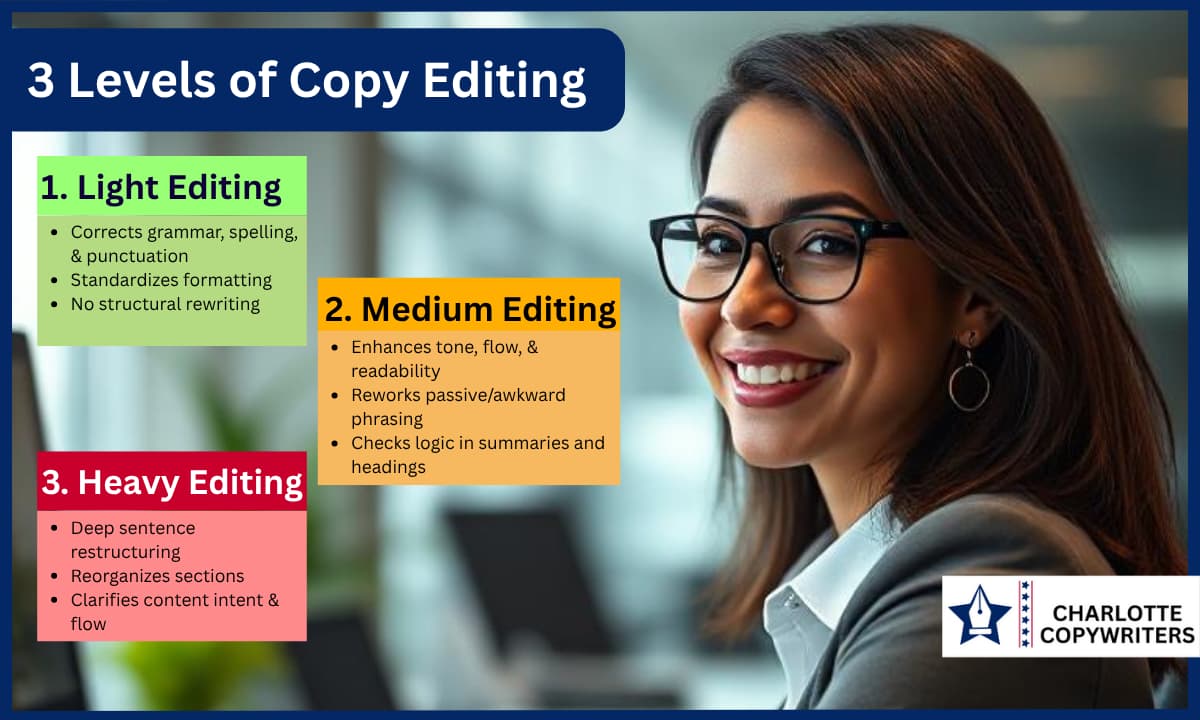
Copy editing occurs after developmental editing and before proofreading. It focuses on refining content for clarity, consistency, correctness, and coherence. The depth of intervention varies across three editorial intensities: Light, Medium, and Heavy. Each level builds upon the previous, progressively expanding the editor’s judgment, structural input, and stylistic refinements.
Light Copy Editing
Light copy editing involves foundational language correction and consistency checks without structural intervention. It is suitable for manuscripts that are well-formed and require only minor refinement prior to final layout.
Key tasks include:
- Correcting grammar, spelling, and punctuation errors.
- Fixing basic word usage (e.g., distinguishing “can” from “may”).
- Standardizing mechanical elements like hyphenation, numerals, fonts, and capitalization (mechanical consistency).
- Verifying sequencing in lists, tables, and references.
- Checking cross-references and internal linkages.
- Typemarking elements for design purposes, if needed.
- Recording first-use citations for figures, tables, or data visualizations.
- Detecting obvious content gaps but not rewriting or restructuring.
This level does not alter text flow or parallelism, and applies predefined brand voice or house style guidelines without recasting sentence structure.
Medium Copy Editing
Medium copy editing adds stylistic normalization and structural alignment to the baseline correction tasks. It is suited for content that requires moderate editorial intervention to enhance coherence and engagement.
Additional responsibilities include:
- Enforcing parallel structure in headings, subheadings, and listicles.
- Tracking terminology consistency and aligning glossary/index entries.
- Querying inappropriate metaphors or ambiguous language.
- Harmonizing tone and style across sections or contributors.
- Revising passive constructions to active, where requested.
- Aligning summaries, previews, or instructional content with the main text.
- For fiction, ensuring plot continuity, character consistency, and setting logic.
- Typemarking and preparing manuscripts for layout if necessary.
Medium copy editing applies editorial judgment to support reader flow and informational clarity, but does not significantly rewrite or restructure content.
Heavy Copy Editing
Heavy copy editing—also known as substantive editing—involves deep intervention at the sentence and paragraph levels. It is applied to drafts requiring intensive polish, realignment, and coherence enhancement before publication.
Scope of work includes:
- Rewriting for clarity, conciseness, and logical flow.
- Reorganizing sentences and blocks of content for narrative coherence.
- Eliminating jargon, verbosity, clichés, and redundancy.
- Suggesting additions or deletions to strengthen content structure.
- Assigning new heading hierarchies to achieve logical segmentation.
- Adjusting voice and tone to meet publication objectives or audience expectations.
- Enhancing transitions and resolving structural gaps.
- Recasting language where flagged problems cannot be resolved by minor edits.
Heavy copy editing entails high editorial discretion. It balances respect for authorial voice with the functional demands of reader accessibility, brand alignment, and publication readiness.
Each level of copy editing delivers a distinct layer of editorial value. Whether minimal linguistic polish or deep structural refinement is required, these levels provide a calibrated editorial process tailored to manuscript condition and publishing goals.
5-Stage Copy Editing Workflow for Blogs
Copy editing for blogs follows a multi-phase progression designed to align with both editorial quality standards and the specific demands of digital publishing. This workflow applies layered interventions to enhance clarity, coherence, and reader engagement—ensuring the text is not only linguistically refined but also strategically prepared for publication in high-scroll, low-attention digital environments.
Structural Review
The process begins with a structural review, where the copy editor evaluates the content architecture. This includes validating the sequence of ideas, section hierarchy, and the effectiveness of transitions. The goal is to ensure that the content structure aligns with narrative intent and that readers can follow the progression without interpretive strain. For blog content, this step also involves optimizing layout logic for mobile readability and user flow.
Line Editing
The second stage addresses sentence-level fluency, stylistic rhythm, and tonal consistency. Here, the editor eliminates redundancy, trims verbose constructions, and revises awkward syntax. Each line is adjusted to balance authorial voice with readability. Emphasis is placed on refining sentence energy, smoothing transitions, and reinforcing narrative cadence—particularly critical in sections employing persuasive, instructional, or narrative styles.
Syntax & Grammar Polish
At this stage, the focus shifts to linguistic mechanics. The editor applies syntactic correction, normalizes stylistic expressions, and enforces grammatical precision. This includes resolving punctuation faults, correcting spelling errors, and ensuring mechanical consistency across capitalization, hyphenation, and abbreviation use. This layer functions as a linguistic integrity check, essential to maintaining professionalism and editorial credibility.
SEO & Formatting Pass
Modern copy editing for digital content extends beyond language to structural metadata and on-page SEO alignment. In this pass, the editor ensures keyword presence, correct heading hierarchies, clean hyperlink structure, and compliance with content formatting best practices. This includes verifying alt-text for images, bulleted list formatting, and HTML tag logic—essential for SERP visibility and accessibility compliance.
Final Proof & Cleanup
The workflow concludes with a precision-focused cleanup stage. The editor integrates any post-query author changes, resolves unresolved ambiguities, and ensures alignment with the project’s style sheet or brand guide. At this point, all typographic integrity, layout uniformity, and citation completeness are revalidated. This phase functions as a readiness assessment prior to publication, ensuring the blog content meets both quality standards and platform-specific expectations.
Modern Tools That Make Copy Editors Superhuman
In digital marketing and content production, leveraging technology is essential for speed and precision. A good copywriter may produce compelling drafts, but a professional copy editor brings the rigor required to refine and finalize content to publishing standards. For copy editors working with Charlotte businesses or managing high-volume editorial workflows, these tools significantly enhance quality control and editorial efficiency.
While even amateur content creators can use digital tools to edit their writing, only trained professionals know which automated suggestions to apply and which to override. This discernment distinguishes professional editing from algorithmic surface-level fixes.
Here are essential tools used by modern copy editors:
- Grammarly: Offers real-time grammar, punctuation, and style corrections, including tone and clarity suggestions.
- Hemingway Editor: Analyzes sentence complexity, passive voice, and readability to streamline prose.
- ProWritingAid: Provides deep language analysis across grammar, style, readability, and repeated phrases.
- Google Docs with Track Changes: Enables collaborative editing, comment threads, and transparent revision workflows.
- Microsoft Word with Track Changes: Industry-standard for professional manuscript editing with robust review features.
- PerfectIt: Checks for consistency in capitalization, hyphenation, abbreviations, and formatting.
- LanguageTool: A multilingual grammar and style checker that works across browsers and applications.
- Scrivener: A drafting and editing tool for long-form content, especially useful in managing complex document structures.
- Adobe Acrobat: Used for final PDF proofreading and markup in print or publishing pipelines.
- CMS Editing Plugins (e.g., Yoast SEO, RankMath): Help integrate on-page SEO checks directly into content management systems like WordPress.
Conclusion
Copy editing is more than grammatical correction—it is the foundation of editorial clarity, brand voice integrity, and digital performance. As content ecosystems evolve, the copy editor’s role becomes increasingly strategic, requiring both linguistic mastery and technical adaptability. Future articles in this series will explore line editing, proofreading distinctions, and brand-specific style guide development to further enhance publishing standards.
References
- https://journalism.ku.edu/what-copy-editing
- https://nationalcareers.service.gov.uk/job-profiles/copy-editor
- https://www.grammarly.com/blog/writing-process/whats-the-difference-between-copy-editing-and-proofreading/
- https://en.wikipedia.org/wiki/Copy_editing